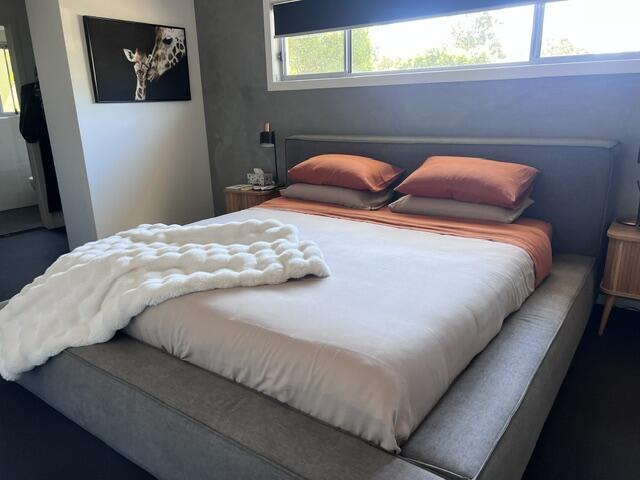
Bedrooms are getting intentional
As daily life grows noisier and more digitally saturated, the spaces we retreat to at night are shifting. Not empty, not austere - but considered. The colour direction for 2026 reflects this clearly. Earthy neutrals are moving to the forefront, paired with a form of minimalism that prioritises wellbeing over visual complexity.
This is not minimalism as a design trend. It is minimalism as a feeling. Rooms that support rest, regulate mood, and create a sense of steadiness at the end of the day.
From cool grey to grounded warmth
For years, cool-toned greys dominated bedroom palettes. They felt clean and contemporary, but often lacked warmth. The shift now is toward colours that feel closer to nature. Warm sand, soft clay, oat, stone, muted olive, gentle eucalypt greens.
These tones carry depth without heaviness. They soften the room rather than flatten it, creating a sense of enclosure that feels protective rather than closed in. They also adapt beautifully to changing light - fresh and airy in the morning, richer and more settled by evening. That subtle shift supports the body’s natural transition toward rest.
It’s exactly why our Pure Linen range is centred on colourways like Flax, Slate, and Blush. Each sits within this warm, nature-informed palette - tones that feel right in the morning and even better at night.
Here's the updated code — just the section between the paste markers, ready to copy: html
Pure Linen — Shop the Collection
The colours defining 2026


Wellness minimalism: less noise, more comfort
Wellness minimalism moves away from the idea that a calm room must be sparse. Instead, it focuses on removing visual friction while keeping tactile comfort. Layers remain, but they are thoughtful. A well-made bed, breathable bedding, soft lighting, and a few meaningful objects replace decorative excess.
The emphasis is on how the room feels rather than how much it contains. When the palette is cohesive and grounded, the mind stops scanning for stimulation. The room becomes easier to settle into.
The rise of nature-informed palettes
Nature continues to influence interior design, but the interpretation is becoming more refined. Rather than obvious greens and florals, colours are drawn from landscapes as a whole - sun-warmed stone, dry grasses, coastal sand, weathered timber.
These references feel familiar without being literal. In bedding, this translates into tones that layer easily together. Flax with warm white. Slate with soft oat. Blush with muted stone. Combinations that feel balanced rather than contrasted.
Our Stonewashed Cotton range was developed with exactly this in mind. The colourways - Red Earth, and the softer neutrals - sit within this grounded palette, and the pre-washed texture gives each colour a depth that flat finishes simply can’t replicate.
Stonewashed Cotton — Shop the Collection
More colours to explore


Texture as part of the colour story
In wellness-focused spaces, colour rarely stands alone. Texture deepens it. Natural fibres like linen and cotton diffuse colour differently from synthetic materials. They soften edges, absorb light, and create a matte, lived-in quality that feels gentle on the eye.
Linen in particular gives earthy tones dimension. Its subtle irregularity prevents colours from feeling flat, allowing them to evolve over time with washing and use. This is part of why Pure Linen remains our most-loved range - the texture and the colour work together in a way that gets better, not worse, over time.
Our Stonewashed Cotton is built on the same principle. Pre-washed for immediate softness, the cotton surface interacts with light in a way that gives each colourway a lived-in warmth from day one.
html
A Closer Look
Our Pure Linen vs Washed Cotton


Soft contrast over stark contrast
Another clear shift for 2026 is the move away from high-contrast schemes. Instead of sharp black and white combinations, softer pairings are emerging. Warm white with oat. Sand with muted taupe. Pale olive with stone.
These combinations create visual interest without tension. The eye moves gently across the room rather than jumping between extremes. For bedrooms, this softer contrast actively supports relaxation - it reduces the sense of alertness that high-contrast environments can produce.
html
Soft Contrast in Practice
Bold colour or clean white - both work


Colour as a daily reset
Bedrooms are increasingly seen as spaces for recovery, not just sleep. Grounded tones can lower visual stimulation and help the nervous system shift out of daytime mode. They create a buffer between the outside world and the private space of rest.
This does not mean colour must be dull. Subtle variation within a narrow palette can feel deeply satisfying. Layers of similar tones build richness without noise. A Flax quilt cover with a warm white sheet and a Slate throw is a good example - three tones, one palette, real depth.
Bringing the forecast into your space
You do not need to redesign an entire room to shift its atmosphere. Updating your bedding is usually the most immediate step, since the bed is the visual centre of the room. Choosing natural tones in breathable fabrics can transform how a space feels.
Consider how colours interact with your existing environment. Earthy neutrals are versatile because they integrate easily with timber, natural light, and existing furnishings. Lighting matters too - warm, diffused light enhances these tones in a way that harsh overhead lighting cannot.
If you’re looking for a starting point, our Pure Linen range in Flax or Slate works across almost any existing bedroom palette. For something with a little more warmth and softness, Stonewashed Cotton in Red Earth or Blush brings the same grounded direction with a cosier hand feel.
A calmer direction for bedroom design
The 2026 colour forecast is less about novelty and more about returning to essentials. Warmth, comfort, and connection to nature are becoming the defining markers of modern bedroom design.
Earthy neutrals and wellness minimalism reflect a broader desire for spaces that support everyday life consistently. Bedrooms that feel grounded, breathable, and restorative. When colour, material, and intention align, the bedroom becomes more than a place to sleep. It becomes a place to reset.
In a world that rarely slows down, that kind of calm is no longer a luxury.